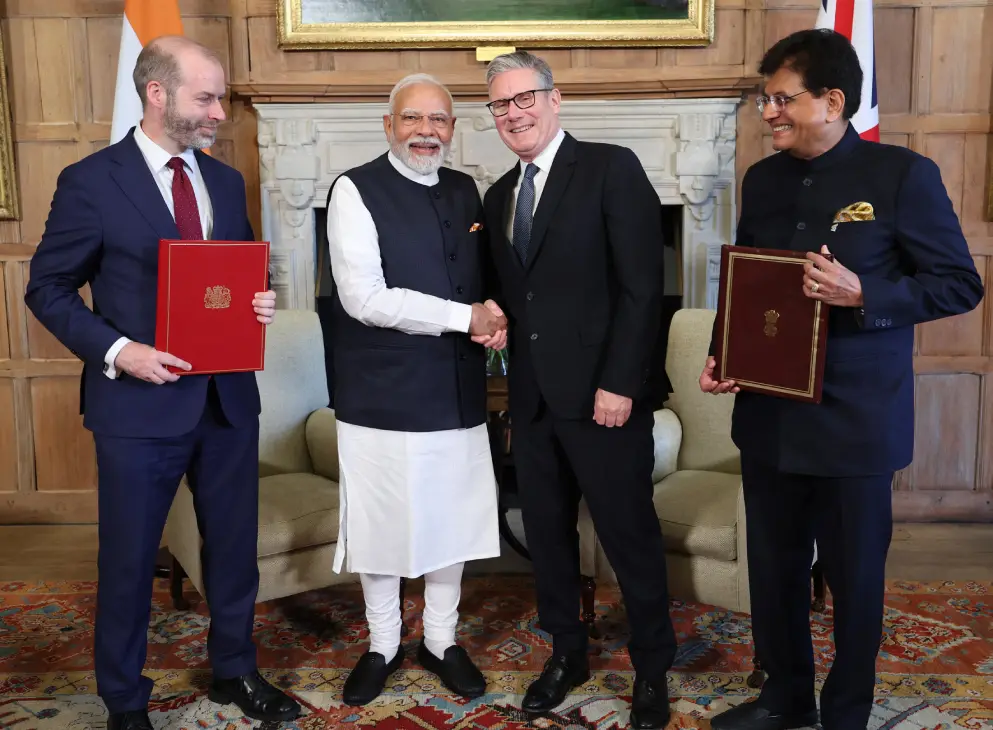
The UK–India Free Trade Agreement is not just a policy change between two countries. It is slowly reshaping how textile industry trade moves across global markets.
Market analysis, including insights highlighted by Elara Capital, suggests that this agreement will strengthen India’s export position and also support a gradual recovery in US textile market share over time.
What this really means is simple: global sourcing patterns are shifting again, and logistics networks are adjusting along with them.
For freight forwarding companies offering international freight forwarding services, this shift is where real opportunity begins.
How Indian Textile Industry is Regaining Market Share in the US
The US textile market has been under pressure for years due to global competition and changing supply chains. Now, a slow recovery cycle is starting to take shape.
India is gaining strength in this shift because of:
- Better trade access through UK–India FTA
- Strong textile manufacturing ecosystem
- Competitive production costs
- Diversification away from China-heavy sourcing
Elara Capital’s outlook suggests that Indian exporters may slowly regain US market share as global buyers rebalance sourcing strategies.
This is not a sudden change. It is a long, gradual cycle.
Why Indian Textile Exporters Are Closely Monitoring This Shift
For Indian textile exporters, the UK–India FTA brings two clear advantages.
First, easier access to the UK market with reduced trade friction.
Second, improved global positioning that indirectly strengthens competitiveness in other key markets, including the US.
This leads to a clear chain reaction:
- Higher export demand
- More container movement
- Faster shipment cycles
- Greater dependence on logistics partners
Exporters increasingly rely on export import logistics solutions to manage this rising complexity efficiently.
And that directly increases the role of freight forwarding companies.
How It Will Impact Freight Forwarding Companies
When textile exports grow, logistics complexity increases even faster.
Freight forwarders will see:
- Higher India–UK sea freight volumes
- More consolidated shipments from textile hubs
- Increased demand for time-sensitive deliveries
- Greater pressure on customs documentation accuracy
- Strong need for cost-efficient routing
This is where specialized sea freight services and air freight logistics play a crucial role depending on shipment urgency.
Textiles move in fast cycles—seasonal demand, fashion trends, and bulk orders.
So logistics providers who understand this rhythm will naturally stay ahead.
Growing UK–India–US Trade Corridor and Its Business Impact
On the surface, the UK–India FTA looks bilateral. But global trade rarely works in straight lines anymore.
Here’s what is actually happening:
- UK becomes a stronger trade and redistribution hub
- India increases export strength across multiple regions
- Global buyers diversify sourcing strategies
- US importers adjust supply chains toward India-linked sourcing
This creates a connected trade network between UK, India, and the US.
For logistics companies, this means:
- Multi-country routing complexity
- Hub-based consolidation in Europe
- Faster coordination across markets
- Higher-value logistics operations
Efficient customs clearance services become critical in managing multi-country trade compliance.
Trade is becoming more networked. Logistics has to evolve with it.
New Opportunity for Freight Forwarding Companies
This is not just a trade update—it is a demand signal.
To stay competitive, freight forwarders should focus on:
- Strengthening India–UK shipping lanes
- Improving shipment visibility systems
- Building textile-specific logistics expertise
- Faster customs clearance processes
- Strong global partner coordination
Businesses offering end-to-end international freight forwarding solutions will be best positioned to capture this growth.
The companies that win this cycle will not just move cargo—they will manage trade flow efficiently.