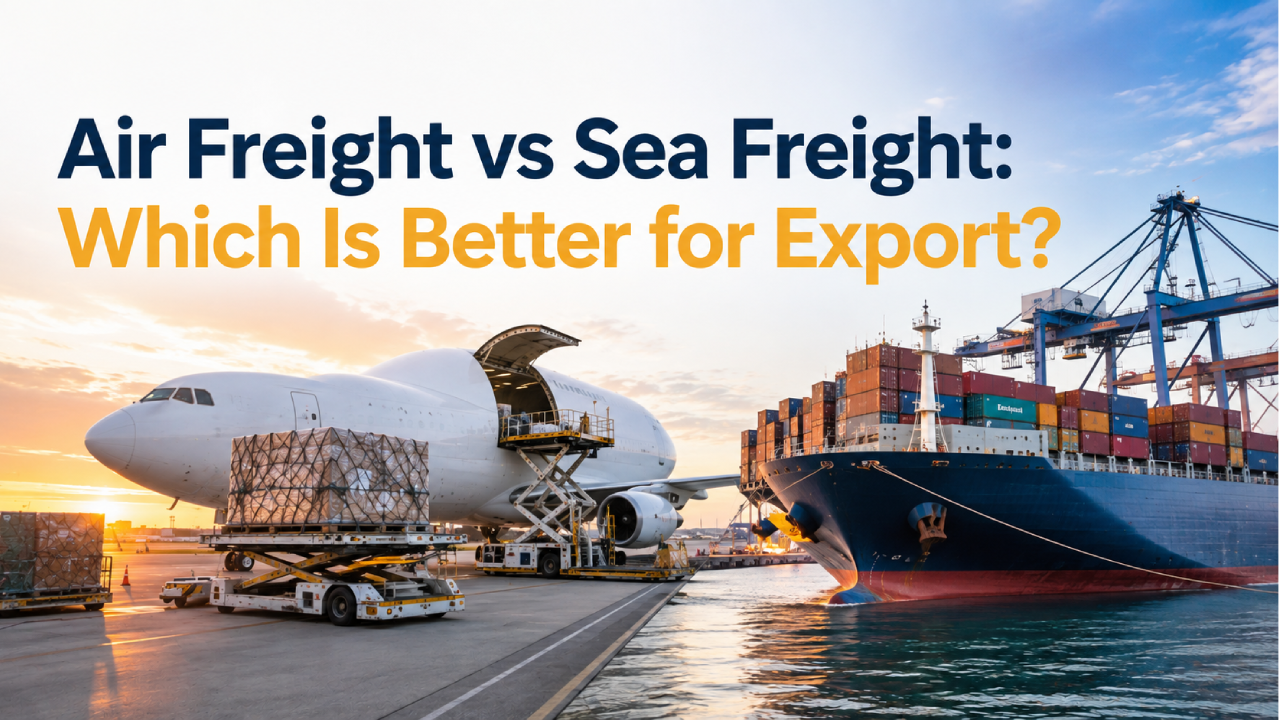
When you are exporting goods internationally, one of the first decisions you have to make is how you want to move the shipment.
Should you choose air freight because it is faster? Or should you go with sea freight because it usually costs less?
The answer is not as simple as choosing the faster or cheaper option.
Your shipment size, product type, delivery deadline, destination, budget, cargo value, and even the nature of your customer’s business can change the right choice.
For example, sending a small shipment of urgent electronic components by sea may save money on freight, but the longer transit time could delay production for your customer. On the other hand, moving several tonnes of non-urgent goods by air could make your logistics cost unnecessarily high.
So, when comparing air freight vs sea freight for export, the better question is not:
“Which one is better?”
It is:
“Which mode makes more sense for this particular shipment?”
Let’s break it down.
What Is Air Freight?
Air freight means transporting cargo from one location to another using commercial or dedicated cargo aircraft.
It is generally preferred when speed matters. Exporters use air cargo for shipments that need to reach the destination quickly or for products where long transit times can create operational or financial problems.
Common examples include:
- Electronics
- Pharmaceuticals
- Medical equipment
- Samples
- Spare parts
- High-value products
- Fashion and seasonal goods
- Perishable products
- Urgent industrial components
- Small eCommerce shipments
Air freight usually offers shorter transit times than ocean freight, but the cost per kilogram is generally higher.
That makes it more suitable for time-sensitive, high-value, lightweight, or relatively small shipments.
What Is Sea Freight?
Sea freight involves transporting cargo by ships between international ports.
It remains one of the most widely used methods for international trade, especially when businesses need to move large quantities of goods.
Exporters commonly use sea freight for:
- Machinery
- Furniture
- Automotive parts
- Textiles
- Consumer goods
- Industrial equipment
- Raw materials
- Chemicals and other permitted cargo
- Large commercial shipments
The biggest advantage of sea freight is its ability to move large volumes at a comparatively lower transportation cost.
The trade-off is time.
A sea shipment can take considerably longer than an air shipment because the overall process involves port handling, vessel schedules, customs procedures, transshipment in some cases, and inland transportation.
Air Freight vs Sea Freight: The Basic Difference
At a very basic level:
Air freight focuses more on speed.
Sea freight focuses more on cost efficiency and capacity.
But there are several other factors you should consider before choosing between them.
| Factor | Air Freight | Sea Freight |
|---|---|---|
| Transit time | Faster | Slower |
| Freight cost | Generally higher | Generally lower for larger volumes |
| Capacity | More limited | Very high |
| Best for | Urgent and high-value cargo | Large and non-urgent shipments |
| Shipment size | Small to medium | Medium to very large |
| Inventory movement | Faster replenishment | Better for planned inventory |
| Packaging considerations | Weight and dimensions matter | Weight and volume both matter |
| Frequency | Often more frequent | Depends on vessel schedules |
| Environmental impact | Generally higher per tonne-km | Generally lower per tonne-km |
| Ideal use | Time-sensitive exports | Cost-sensitive bulk exports |
These are general comparisons. Actual transit time and cost depend on the origin, destination, carrier, route, cargo, season, and service selected.
Air Freight vs Sea Freight Cost
Cost is usually the first thing exporters compare.
And yes, air freight generally costs more than sea freight, particularly for heavier and larger shipments.
But simply comparing the rate per kilogram does not always give you the full picture.
Air freight pricing can depend on:
- Actual weight
- Volumetric weight
- Chargeable weight
- Fuel surcharges
- Security charges
- Handling fees
- Airport charges
- Customs-related costs
- Documentation
- Pickup and delivery
Sea freight pricing can involve:
- Ocean freight
- Container charges
- Origin handling
- Documentation
- Port charges
- Customs clearance
- Destination charges
- Inland transportation
- Container-related charges
- Other applicable surcharges
So, when comparing air and sea freight, compare the total logistics cost, not just the headline freight rate.
When Is Air Freight More Cost-Effective?
This might sound strange because air freight is usually more expensive.
But there are situations where paying more for transportation can make financial sense.
Imagine you manufacture a product that your overseas customer sells during a specific season.
Your shipment is delayed by three weeks.
You may save money by choosing sea freight, but if your customer misses the selling period, the overall business impact could be much greater than the additional air freight cost.
The same applies when a factory is waiting for a critical component.
If a missing part stops production, paying more for faster transportation may prevent a much larger loss.
So, air freight can make sense when:
- Delivery deadlines are tight
- Stockouts are expensive
- Products have a short selling window
- The shipment has high value relative to its weight
- The customer needs urgent replenishment
- Production depends on the shipment
- The shipment quantity is relatively small
In these situations, time itself has a cost.
When Is Sea Freight the Better Choice?
Sea freight generally makes more sense when you have enough time and need to move a larger quantity of goods.
Suppose you are exporting 15 tonnes of furniture to another country.
If the customer has planned inventory several weeks in advance, there may be little reason to pay a premium for air transportation.
Sea freight can be more practical because you can move a much larger volume at a lower transportation cost per unit.
Sea freight is often suitable when:
- The shipment is large or heavy
- Delivery is not urgent
- You are moving regular inventory
- Your products have a longer shelf life
- You want to control transportation costs
- You are shipping full containers
- You can plan your inventory in advance
For many exporters, this makes ocean freight the default option for regular bulk shipments.
Transit Time: Air Freight vs Sea Freight
This is probably the biggest difference between the two modes.
Air freight can move cargo between international markets much faster than sea freight.
However, you should not look only at the time an aircraft or vessel spends moving between two locations.
The actual export timeline can include:
- Cargo pickup
- Packaging
- Export documentation
- Customs clearance
- Origin handling
- Airport or port processing
- Main transportation
- Destination handling
- Import customs clearance
- Final delivery
So, the actual door-to-door transit time can be different from the advertised flight or sailing time.
For example, a shipment may have a short flight time but still require additional time for airport handling and customs procedures.
The same principle applies to sea freight.
This is why exporters should ask for an estimated end-to-end transit time, rather than comparing only flight duration with sailing duration.
Which Is Better for Small Shipments?
For small and urgent shipments, air freight is often the more practical choice.
Imagine you need to export:
- 50 kg of engineering components
- 100 kg of samples
- A few cartons of electronic products
Using a full sea container would obviously not make sense.
You can use options such as air cargo or consolidated ocean freight, depending on the shipment and delivery requirement.
Air freight can become particularly attractive when the shipment is small enough that the higher air freight rate does not outweigh the operational benefit of faster delivery.
However, the shipment dimensions still matter.
A lightweight but very bulky shipment can have a high volumetric weight, which can increase the air freight chargeable weight.
Which Is Better for Large Shipments?
For large commercial shipments, sea freight usually has a clear advantage in terms of capacity and cost efficiency.
If you need to move several tonnes of cargo, using ocean freight can make more sense than paying the much higher cost of moving the same volume by air.
Sea freight can accommodate:
- Full Container Load (FCL)
- Less than Container Load (LCL)
- Oversized cargo
- Heavy machinery
- Large quantities of commercial goods
The exact option depends on the shipment volume, cargo characteristics, origin, destination, and available services.
Air Freight vs Sea Freight for High-Value Goods
High-value cargo requires a slightly different approach.
Suppose you are exporting products worth ₹1 crore.
If you keep the cargo in transit for a much longer period simply to reduce transportation costs, you also need to consider inventory carrying costs, insurance, security, and the financial impact of delayed delivery.
Air freight may be attractive for high-value goods because it can reduce transit time.
This does not mean every expensive product should automatically travel by air.
You still need to consider:
- Product weight
- Shipment volume
- Security requirements
- Insurance
- Customer deadline
- Destination
- Total logistics cost
The value of the cargo is one factor, not the only factor.
Can You Use Air and Sea Freight Together?
Yes.
This approach can be useful when you want to balance speed and cost.
For example, suppose you have a large order.
You could send the majority of the inventory by sea because it is not urgent.
At the same time, you could send a smaller quantity by air so that the customer receives some stock quickly.
This can help businesses avoid a complete stockout while keeping the overall transportation cost under control.
The right approach depends on your inventory requirements and customer commitments.
Air Freight vs Sea Freight: Which Is More Reliable?
Reliability does not simply mean "faster."
A transportation mode can be fast but still experience delays because of weather, airport congestion, customs, operational issues, or capacity constraints.
Sea freight can also face delays due to:
- Port congestion
- Vessel schedule changes
- Weather
- Transshipment
- Customs
- Equipment shortages
- Operational disruptions
Air freight can also experience:
- Flight cancellations
- Capacity limitations
- Airport congestion
- Security delays
- Customs delays
- Weather-related disruption
The reliability of a shipment therefore depends on the entire logistics chain.
A good logistics plan should include some buffer instead of planning delivery around the absolute minimum transit time.
Air Freight vs Sea Freight and Customs Clearance
Customs clearance is required for international exports regardless of whether you choose air or sea freight.
The documents and procedures can vary depending on the product, country, mode of transport, and shipment type.
Exporters may need documents such as:
- Commercial invoice
- Packing list
- Shipping bill
- Airway bill for air shipments
- Bill of lading for sea shipments
- Certificate of origin, where applicable
- Product-specific certificates
- Other regulatory documents, depending on the cargo
Incorrect or incomplete documentation can delay either type of shipment.
So, choosing air freight does not mean you can ignore customs timelines.
In fact, when your delivery deadline is tight, documentation should be ready well before the cargo reaches the airport or port.
Air Freight vs Sea Freight: Environmental Considerations
Environmental impact is becoming an important factor in logistics planning.
Air transportation generally produces more emissions per unit of cargo moved compared with ocean transportation.
Sea freight can move very large quantities of cargo using relatively less energy per tonne-kilometre.
However, the environmental impact of a shipment depends on several factors, including:
- Cargo weight
- Distance
- Transportation mode
- Vessel or aircraft efficiency
- Route
- Shipment utilization
- Inland transportation
If your shipment is not urgent, choosing sea freight can often provide a lower-emission transportation option than air freight.
For businesses with sustainability targets, transportation mode should therefore be part of the overall logistics planning process.
How to Decide Between Air Freight and Sea Freight
Instead of making the decision based on one factor, look at these seven questions.
1. How urgent is the shipment?
If your customer needs the goods quickly, air freight may be more suitable.
If you have several weeks of flexibility, sea freight may work better.
2. How much cargo are you shipping?
Small shipments can be easier to move by air.
Large commercial shipments usually benefit from ocean freight's capacity.
3. What is the cargo worth?
High-value cargo may justify faster transportation, especially when inventory carrying costs are significant.
4. What is the cargo's weight and volume?
A heavy or bulky shipment can become expensive by air.
Always calculate the chargeable weight before deciding.
5. How much does delay cost your business?
This is often overlooked.
If a delay can stop production, cause a stockout, or make you miss a seasonal selling window, faster transportation may be worth the additional cost.
6. How much can you spend on transportation?
If transportation cost is the biggest concern and you have sufficient time, sea freight may be the better option.
7. What does the complete logistics cost look like?
Do not compare only the basic freight rate.
Consider the complete door-to-door cost.
A Simple Example: Choosing Between Air and Sea Freight
Let's say you are exporting 2,000 kg of consumer products.
You have two options.
Option A: Air Freight
- Faster delivery
- Higher freight cost
- Suitable for urgent replenishment
- Better when the customer cannot wait
Option B: Sea Freight
- Longer transit
- Lower transportation cost for the larger shipment
- Better suited to planned inventory
- Requires more advance planning
Now imagine the customer has enough inventory for six weeks.
Sea freight may make more sense.
But if the customer will run out of stock in ten days, the decision changes.
You could also split the shipment:
- Send a smaller quantity by air
- Send the remaining quantity by sea
This gives you a middle ground between cost and speed.
Air Freight vs Sea Freight: Pros and Cons
Air Freight
Advantages
- Faster transit
- Suitable for urgent shipments
- Useful for high-value goods
- Good for smaller shipments
- Helps with quick inventory replenishment
- Suitable for many time-sensitive products
Disadvantages
- Higher freight cost
- Weight and dimensional weight can significantly affect pricing
- Limited capacity compared with ocean freight
- Generally higher emissions per unit of cargo
- Oversized and very heavy cargo may be difficult or expensive to move
Sea Freight
Advantages
- Cost-effective for larger shipments
- High cargo capacity
- Suitable for heavy and bulky goods
- Multiple container options
- Better suited to planned inventory movement
- Generally lower emissions per tonne-kilometre than air freight
Disadvantages
- Longer transit time
- Requires more advance planning
- Port congestion can affect schedules
- Delays can have a greater impact on time-sensitive cargo
- Additional port and handling processes can affect the final cost
So, Which Is Better for Export: Air or Sea?
There is no universal answer.
Choose air freight when time has a higher value than transportation cost.
Choose sea freight when transportation cost and large-volume capacity matter more than speed.
For example:
| Situation | More Suitable Option |
|---|---|
| Urgent spare parts | Air freight |
| Large machinery shipment | Sea freight |
| Small high-value shipment | Air freight |
| Large non-urgent inventory | Sea freight |
| Seasonal products with a short deadline | Air freight |
| Regular bulk exports | Sea freight |
| Production-critical components | Air freight |
| Planned replenishment with sufficient inventory | Sea freight |
| Very large commercial shipment | Sea freight |
| Small sample shipment | Air freight |
These are general guidelines, not fixed rules. The right choice depends on your specific shipment.
Final Takeaway
The air freight vs sea freight decision is not simply about fast versus cheap.
You need to look at the entire shipment.
Consider the cargo's weight and dimensions, delivery deadline, product value, inventory requirements, destination, customs requirements, and the cost of a potential delay.
If you are shipping a small and urgent consignment, air freight may justify its higher cost.
If you are moving large quantities of goods and have enough time, sea freight will often be more practical.
And sometimes, the best approach is to use both.
Send the urgent portion by air and move the rest by sea.
That way, you are not choosing transportation based on a general rule. You are choosing it based on what your business actually needs.