Global logistics is changing faster than ever. Businesses today need greater visibility, faster shipment updates, and better control over international shipping operations. This shift has created a growing debate between digital freight forwarding and traditional freight forwarding. While both models help move cargo across borders, they differ significantly in how shipments are booked, tracked, managed, and communicated. Understanding these differences can help importers, exporters, manufacturers, and eCommerce businesses choose the right logistics partner for their supply chain needs.
Digital freight forwarding uses technology to automate booking, tracking, documentation, and shipment management. Traditional freight forwarding relies on manual processes, personal communication, and logistics expertise. Businesses looking for speed, transparency, and automation often prefer digital solutions, while those handling complex cargo or specialized shipments may benefit from traditional freight forwarding services.
What Is Traditional Freight Forwarding?
Traditional freight forwarding has supported international trade for decades. In this model, freight forwarders coordinate cargo movement through direct communication with shipping lines, airlines, trucking companies, customs authorities, and warehouse operators.
Most activities are managed through emails, phone calls, and personal interactions. Shipment updates, documentation, customs clearance, and transportation planning often involve significant human involvement.
Key Features of Traditional Freight Forwarding
- Relationship-driven service
- Manual documentation and paperwork
- Communication through phone and email
- Customized logistics planning
- Strong industry connections
- Hands-on shipment management
- Experience-based problem solving
Traditional freight forwarding remains popular among businesses handling oversized cargo, project shipments, hazardous goods, and specialized logistics requirements.
What Is Digital Freight Forwarding?
Digital freight forwarding uses technology platforms to simplify and streamline logistics operations. Businesses can obtain freight rates, book shipments, track cargo, manage documents, and monitor supply chain performance through a centralized online platform.
The objective is to improve visibility, reduce delays, minimize paperwork, and provide greater control over shipping operations.
Key Features of Digital Freight Forwarding
- Online shipment booking
- Instant freight quotations
- Real-time cargo tracking
- Automated documentation
- Cloud-based logistics dashboards
- Data analytics and reporting
- Centralized shipment management
As global supply chains become more complex, digital freight forwarding is helping businesses manage logistics more efficiently.
Actual Weight vs Volumetric Weight in Air Freight: What’s the Difference?: Comparison Table
| Feature | Digital Freight Forwarding | Traditional Freight Forwarding |
|---|---|---|
| Shipment Booking | Online and automated | Manual process |
| Freight Quotes | Instant pricing | Usually takes longer |
| Shipment Tracking | Real-time visibility | Periodic updates |
| Documentation | Automated and digital | Manual paperwork |
| Communication | Platform-based | Calls and emails |
| Transparency | High visibility | Limited visibility |
| Customer Support | Digital and human support | Dedicated personal support |
| Scalability | Highly scalable | Depends on operational capacity |
| Decision Making | Data-driven | Experience-driven |
| Complex Shipments | May require extra support | Often better suited |
Benefits of Digital Freight Forwarding
The growing demand for speed and visibility has encouraged many businesses to adopt digital logistics solutions.
Faster Freight Management
Digital platforms eliminate many manual tasks involved in obtaining quotations, booking shipments, and preparing shipping documents. This speeds up logistics operations and reduces administrative workload.
Real-Time Shipment Visibility
One of the biggest advantages of digital freight forwarding is complete shipment transparency. Businesses can track cargo movement at every stage and receive updates instantly.
This visibility helps improve inventory planning and customer communication.
Improved Operational Efficiency
Automation reduces repetitive work and lowers the risk of human errors in documentation, shipment scheduling, and reporting.
Better Data and Analytics
Digital freight forwarding platforms provide insights into:
- Freight spending
- Carrier performance
- Transit times
- Shipment delays
- Logistics trends
These insights help businesses make better supply chain decisions.
Easier Document Management
Shipping documents, customs paperwork, invoices, and compliance records can be stored and accessed digitally, reducing paperwork and improving organization.
Advantages of Traditional Freight Forwarding
Despite advances in logistics technology, traditional freight forwarding continues to offer several important benefits.
Personalized Customer Support
Businesses often value direct access to experienced logistics professionals who understand specific shipping requirements and industry challenges.
Expertise in Complex Logistics
Certain shipments require detailed planning and coordination, including:
- Project cargo
- Oversized freight
- Heavy machinery
- Dangerous goods
- Temperature-controlled shipments
Traditional freight forwarders often provide the expertise needed for these specialized movements.
Strong Industry Relationships
Long-standing relationships with carriers, customs authorities, and transport providers can help resolve issues quickly and improve shipment reliability.
Flexible Problem Solving
Unexpected disruptions can occur during international transportation. Experienced freight professionals can often identify practical solutions faster than automated systems alone.
Which Freight Forwarding Model Is More Cost Effective?
Cost effectiveness depends on the nature of your logistics operations.
Digital freight forwarding typically reduces administrative expenses through automation and streamlined workflows. Businesses with regular shipment volumes often benefit from improved efficiency and lower operational costs.
Traditional freight forwarding may provide better value for businesses managing specialized cargo, custom logistics projects, or shipments that require extensive coordination.
Rather than focusing only on freight rates, businesses should evaluate:
- Service quality
- Shipment visibility
- Customer support
- Reliability
- Transit performance
- Operational efficiency
The lowest freight rate does not always deliver the best overall value.
How Technology Is Transforming Freight Forwarding
Technology is reshaping global logistics and supply chain management.
Several innovations are driving this transformation:
- Artificial Intelligence (AI)
- Real-time cargo tracking
- Cloud-based logistics software
- Electronic documentation
- Predictive analytics
- Supply chain visibility tools
- Automated customs processes
These technologies help freight forwarders improve efficiency, reduce delays, and provide better customer experiences.
Technology is not replacing freight forwarders. Instead, it is enhancing their ability to deliver reliable logistics services.
Which Freight Forwarding Solution Is Right for Your Business?
The right choice depends on your shipping volume, cargo type, and operational priorities.
Choose Digital Freight Forwarding If You:
- Need real-time shipment visibility
- Ship frequently across international markets
- Prefer automated workflows
- Want data-driven logistics insights
- Need faster access to freight rates and updates
Choose Traditional Freight Forwarding If You:
- Handle specialized or oversized cargo
- Require customized logistics planning
- Value direct communication with experts
- Need support for complex supply chain challenges
- Prefer relationship-based service
Consider a Hybrid Approach
Many businesses are finding success with a hybrid logistics model.
Modern freight forwarders increasingly combine advanced technology with experienced logistics professionals. This approach provides the visibility and efficiency of digital platforms while maintaining the expertise and personalized support of traditional freight forwarding.
Conclusion
The discussion around Actual Weight vs Volumetric Weight in Air Freight: What’s the Difference? is not about replacing one model with another. Both approaches offer unique advantages depending on business requirements.
Digital freight forwarding delivers speed, automation, visibility, and operational efficiency. Traditional freight forwarding provides industry expertise, personalized service, and customized logistics solutions.
As supply chains continue to evolve, businesses should focus on choosing a logistics partner that aligns with their operational goals, shipment requirements, and growth plans. Whether you choose a digital platform, a traditional freight forwarder, or a hybrid solution, the objective remains the same: moving cargo efficiently, reliably, and cost-effectively across global markets.
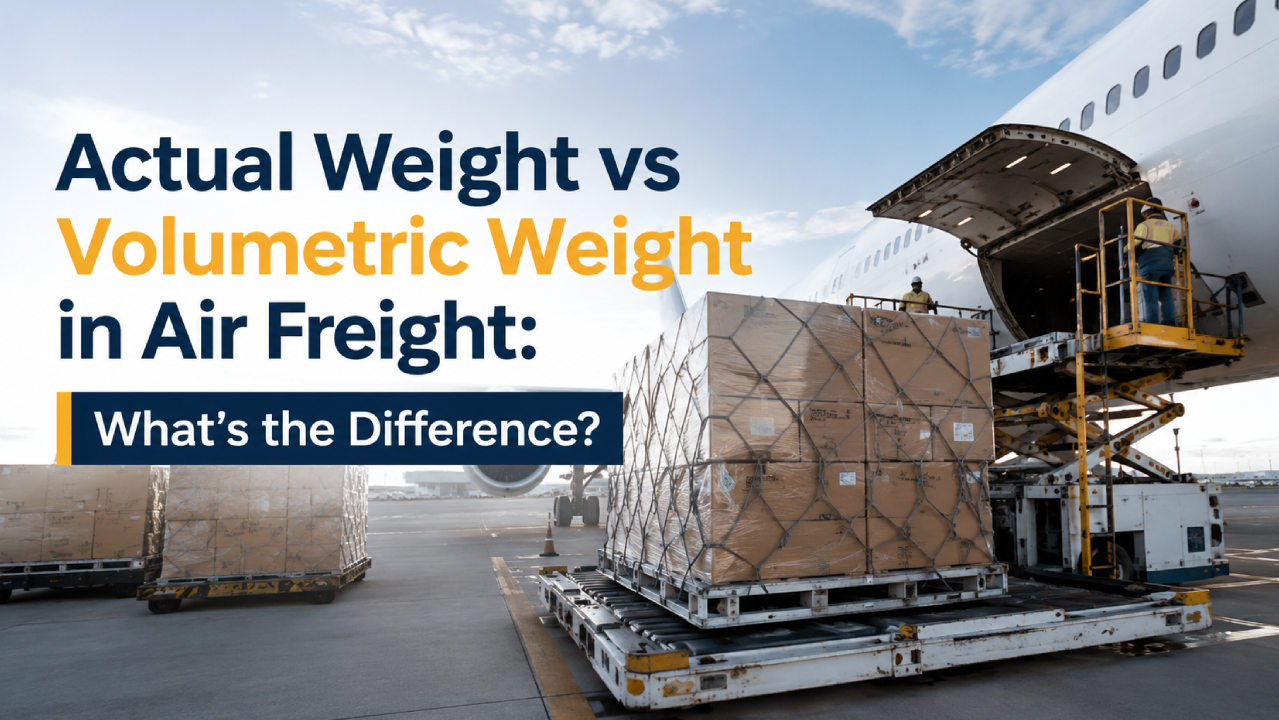
When you ship cargo by air, the weight you see on the weighing scale is not always the weight the airline uses to calculate freight charges.
This often creates confusion for businesses sending air cargo for the first time. A shipment may weigh only 50 kg physically, but the freight charge can be based on 80 kg or 100 kg. Nothing is wrong with the weighing scale. The difference comes from volumetric weight.
Air freight carriers consider both the actual weight and the amount of space a shipment occupies inside an aircraft. This matters because aircraft cargo capacity is limited not only by how much weight the aircraft can carry but also by how much physical space is available.
That is why air freight pricing usually depends on chargeable weight, which is determined by comparing the shipment's actual weight with its volumetric weight.
Understanding this difference can help importers, exporters, manufacturers, eCommerce businesses, and logistics teams estimate air freight costs more accurately and avoid unexpected charges.
What Is Actual Weight in Air Freight?
Actual weight is the physical weight of your shipment measured using a weighing scale.
It includes the cargo and, depending on the carrier's weighing and billing procedure, the packaging used to prepare the shipment for transportation.
For example, suppose you are shipping 10 cartons of machine components.
If the total shipment weighs: 75 kg
then the actual weight of the shipment is 75 kg.
Actual weight is also commonly called:
- Gross weight
- Physical weight
- Scale weight
- Dead weight
The exact terminology can vary between carriers, freight forwarders, and shipping documents, but the basic idea remains the same: it represents how much the shipment physically weighs.
Example of actual weight
Suppose you have:
20 cartons
Each carton weighs 8 kg
Total cartons = 20
Your actual weight would be:
20 × 8 = 160 kg
So, your shipment has an actual weight of 160 kg.
However, the airline may not necessarily charge you for 160 kg.
You still need to calculate the shipment's volumetric weight.
What Is Volumetric Weight in Air Freight?
Volumetric weight, also known as dimensional weight, estimates the amount of space your shipment occupies compared with its physical weight.
This becomes particularly important when you ship cargo that is large but relatively light.
Think about the difference between these two shipments:
Shipment A
A compact box containing metal components:
Dimensions: 50 × 40 × 40 cm
Weight: 40 kg
Shipment B
A large carton containing lightweight plastic products:
Dimensions: 100 × 80 × 70 cm
Weight: 20 kg
Shipment B weighs less, but it occupies considerably more space.
If an airline charged only according to actual weight, a lightweight but bulky shipment could take up valuable aircraft space while generating very little freight revenue.
Volumetric weight helps carriers account for this space.
In simple terms:
Actual weight tells you how heavy the shipment is. Volumetric weight tells you how much space that weight occupies.
The airline or freight forwarder compares both figures to determine the chargeable weight.
Why Do Airlines Use Volumetric Weight?
Aircraft have two major cargo limitations:
- Weight capacity
- Available cargo space
Imagine an aircraft carrying two different shipments.
One shipment contains 1,000 kg of dense metal parts packed into a relatively small space.
Another shipment weighs only 300 kg but fills several large pallets because the goods are lightweight and bulky.
If the airline charged both shipments only according to their actual weight, the second shipment would consume much more cargo space without paying for the space it occupies.
Volumetric weight addresses this issue.
It creates a common way to account for shipments that are large in size but light in weight.
This is especially relevant for cargo such as:
- Garments
- Textiles
- Furniture components
- Plastic products
- Foam products
- Empty packaging
- Promotional materials
- Certain consumer goods
- Lightweight machinery parts
- eCommerce shipments
The concept is not unique to air freight. You may also encounter dimensional-weight calculations in courier and other transportation services, although the formulas and divisors can differ.
How to Calculate Volumetric Weight in Air Freight
The basic formula for air freight volumetric weight is:
Volumetric Weight (kg) = Length (cm) × Width (cm) × Height (cm) ÷ Volumetric Divisor
A commonly used air freight divisor is:
6000
So the formula becomes:
Volumetric Weight = L × W × H ÷ 6000
However, the divisor can vary depending on the carrier, service, trade lane, and shipment terms.
Always confirm the applicable divisor with your airline, freight forwarder, or carrier before calculating the final freight cost.
Volumetric Weight Example
Suppose you have one carton with these dimensions:
Length: 100 cm
Width: 60 cm
Height: 50 cm
The volume is:
100 × 60 × 50 = 300,000 cubic centimetres
Now divide it by 6000:
300,000 ÷ 6000 = 50 kg
Therefore:
Volumetric weight = 50 kg
Now assume the carton's actual weight is only 35 kg.
You have:
Actual weight = 35 kg
Volumetric weight = 50 kg
The shipment occupies space equivalent to 50 kg under the applicable dimensional-weight calculation.
Therefore, the chargeable weight would generally be based on 50 kg, subject to the carrier's rounding and billing rules.
What Is Chargeable Weight in Air Freight?
This is the part that matters most when estimating your air freight cost.
Chargeable weight is the weight used by the carrier or freight forwarder to calculate the transportation charge.
In a typical air freight calculation:
Chargeable Weight = Higher of Actual Weight or Volumetric Weight
Let's look at two examples.
Example 1: Actual weight is higher
Actual weight: 80 kg
Volumetric weight: 65 kg
The higher value is 80 kg.
Therefore: Chargeable weight = 80 kg
Example 2: Volumetric weight is higher
Actual weight: 80 kg
Volumetric weight: 110 kg
The higher value is 110 kg.
Therefore: Chargeable weight = 110 kg
This is why a shipment can weigh 80 kg on a scale but still be billed at 110 kg.
The carrier is not claiming that the cargo physically weighs 110 kg. It is using 110 kg as the chargeable or dimensional equivalent based on the space occupied.
Actual Weight vs Volumetric Weight vs Chargeable Weight
These three terms are closely related but mean different things.
| Term | Meaning |
|---|---|
| Actual Weight | Physical weight measured on a scale |
| Volumetric Weight | Weight calculated from the shipment's dimensions |
| Chargeable Weight | Weight used to calculate freight charges |
A simple way to remember this is:
Actual weight = What it weighs
Volumetric weight = How much space it takes
Chargeable weight = What the freight charge is based on
For most standard air freight shipments, the carrier compares actual and volumetric weight and uses the higher figure.
How to Calculate Chargeable Weight
Let's take a more realistic example.
Suppose you are exporting 15 cartons.
Each carton measures: 80 × 60 × 50 cm
Each carton weighs: 18 kg
Step 1: Calculate actual weight
15 cartons × 18 kg:
Actual weight = 270 kg
Step 2: Calculate volumetric weight
First calculate the volume of one carton:
80 × 60 × 50 = 240,000 cm³
Divide by 6000:
240,000 ÷ 6000 = 40 kg
Volumetric weight per carton: 40 kg
For 15 cartons:
15 × 40 = 600 kg
So:
Actual weight = 270 kg
Volumetric weight = 600 kg
The volumetric weight is much higher.
Therefore: Chargeable weight = 600 kg
Even though the cargo physically weighs only 270 kg, the shipment occupies aircraft space equivalent to 600 kg under this calculation.
That difference can have a major impact on your air freight cost.
Why Packaging Can Increase Your Air Freight Cost
Packaging protects your goods, but excessive packaging can increase the shipment's dimensions and therefore its volumetric weight.
This is particularly important for lightweight products.
For example, suppose a product weighs 5 kg.
You could pack it in a compact box measuring: 40 × 30 × 25 cm
But if the same product goes into a much larger box measuring: 70 × 50 × 40 cm
the product's actual weight has not changed.
However, its volumetric weight has increased significantly.
This means two identical products can have different freight costs simply because they use different packaging.
That is why businesses should look beyond product weight when planning air shipments.
Actual Weight and Volumetric Weight: A Practical Example
Suppose an Indian manufacturer exports 100 lightweight textile packages to a customer in Europe.
The total actual weight is: 400 kg
The shipment occupies: 5 cubic metres
Using a volumetric factor of 167 kg per cubic metre, the volumetric weight would be approximately:
5 × 167 = 835 kg
So:
Actual weight = 400 kg
Volumetric weight = 835 kg
Chargeable weight = 835 kg
The shipment does not suddenly become physically heavier.
Instead, its size makes it expensive to move by air because it occupies significantly more aircraft capacity than a dense 400 kg shipment would.
This is one reason businesses shipping lightweight goods should pay close attention to packaging and cargo dimensions.
What Is the Difference Between Gross Weight and Volumetric Weight?
These terms are sometimes confused.
Gross weight refers to the physical weight of the shipment, generally including packaging.
Volumetric weight is not a physical measurement. It is a calculated figure based on dimensions.
For example:
A packed shipment may have:
Gross weight: 200 kg
Volumetric weight: 350 kg
The cargo still physically weighs 200 kg.
But if the carrier uses the higher figure for billing, the chargeable weight becomes 350 kg.
This distinction becomes especially important when reviewing commercial invoices, packing lists, airway bills, and freight quotations.
How Dimensions Affect Volumetric Weight
The formula uses three dimensions:
Length × Width × Height
That means even a small increase in any dimension can increase volumetric weight.
For example:
Box A
100 × 50 × 40 cm
Volume:
200,000 cm³
Volumetric weight:
200,000 ÷ 6000 = 33.33 kg
Box B
110 × 55 × 45 cm
Volume:
272,250 cm³
Volumetric weight:
272,250 ÷ 6000 = 45.38 kg
The physical product inside may be identical.
But the larger packaging increases the calculated volumetric weight from approximately 33.3 kg to 45.4 kg.
This is why accurate packing dimensions matter when requesting an air freight quotation.
Do All Air Freight Shipments Use the Same Volumetric Divisor?
No.
The volumetric divisor can vary depending on the carrier, service, route, and applicable pricing rules.
A divisor of 6000 is commonly used in air freight calculations, but businesses should not assume that every shipment will use exactly the same divisor.
You may see different dimensional factors in:
- Airline cargo rates
- Express shipments
- Courier services
- Consolidated air freight
- Special cargo services
For this reason, you should confirm the calculation method before comparing freight quotations from different providers.
A quote that appears cheaper on a per-kilogram basis may not actually be cheaper if one provider uses a different chargeable-weight calculation or applies additional fees.
Why Chargeable Weight Matters When Comparing Air Freight Quotes
Suppose two freight forwarders give you these rates:
Forwarder A: ₹250/kg
Forwarder B: ₹220/kg
At first glance, Forwarder B looks cheaper.
But now consider the chargeable weight.
Forwarder A:
500 kg × ₹250 = ₹125,000
Forwarder B:
650 kg × ₹220 = ₹143,000
The lower per-kilogram rate does not necessarily mean a lower total freight cost.
This is why businesses should compare the complete quotation, including:
- Chargeable weight
- Freight rate
- Fuel surcharge
- Security surcharge
- Handling charges
- Documentation charges
- Customs-related charges
- Destination charges
- Other applicable fees
The exact charges depend on the shipment, route, carrier, and service.
How to Reduce Volumetric Weight in Air Freight
You cannot always change the dimensions of your product, but you can often improve how you package and prepare the shipment.
1. Review Your Packaging Size
Avoid using unnecessarily large cartons.
If your product fits safely into a smaller box, reducing the external dimensions can lower volumetric weight.
However, do not compromise product protection simply to reduce package size.
2. Avoid Excessive Empty Space
Large amounts of empty space inside cartons can increase the external dimensions without adding useful cargo.
Use appropriately sized packaging wherever possible.
For fragile goods, however, maintain sufficient protective material to prevent damage.
3. Consolidate Small Shipments
If you regularly send several small shipments, ask your freight forwarder whether consolidation could make operational and financial sense.
Consolidation can help businesses manage cargo more efficiently, although the final cost depends on the shipment profile and service arrangement.
4. Optimize Pallet Dimensions
For palletized cargo, pallet dimensions can significantly affect the total shipment volume.
A poorly planned pallet can create unused space around or above the cargo.
Discuss pallet configuration with your logistics team before dispatch, especially for regular air exports.
5. Provide Accurate Dimensions
Always provide the correct:
- Length
- Width
- Height
- Number of packages
- Gross weight
Incorrect dimensions can result in a difference between the estimated and final chargeable weight.
Airlines or handling facilities may also reweigh or remeasure shipments.
Common Mistakes Businesses Make
Mistake 1: Calculating Freight Only From Actual Weight
A business may say:
"My shipment weighs 100 kg, so I only need the rate for 100 kg."
That may not be enough.
You should calculate volumetric weight before estimating the final freight cost.
Mistake 2: Ignoring Packaging Dimensions
Businesses sometimes provide only product weight while requesting a freight quotation.
For air cargo, dimensions are equally important for many shipments.
Always provide complete packing details.
Mistake 3: Assuming Every Carrier Uses the Same Formula
Different carriers and services can have different calculation rules.
Confirm the applicable divisor and rounding method before making a final estimate.
Mistake 4: Comparing Only the Per-Kilogram Rate
A lower rate does not automatically mean a lower total cost.
Compare the complete quotation and the chargeable weight used by each provider.
Mistake 5: Treating Volumetric Weight as Actual Weight
Volumetric weight is a calculated figure.
If your shipment has:
Actual weight = 250 kg
Volumetric weight = 400 kg
the cargo does not physically weigh 400 kg.
The carrier may simply use 400 kg as the chargeable weight.
When Does Volumetric Weight Matter Most?
Volumetric weight becomes particularly important when your cargo has a low weight-to-volume ratio.
Examples include:
- Apparel and textiles
- Cushions
- Foam products
- Plastic products
- Lightweight consumer goods
- Large promotional materials
- Certain furniture components
- Bulky packaging materials
- Some eCommerce products
On the other hand, dense products such as metals, machinery parts, and certain industrial components may have an actual weight higher than their volumetric weight.
For these shipments, actual weight may determine the chargeable weight.
Actual Weight vs Volumetric Weight: Quick Comparison
| Factor | Actual Weight | Volumetric Weight |
|---|---|---|
| Based on | Physical weight | Shipment dimensions |
| Measured or calculated? | Measured | Calculated |
| Depends on dimensions? | No | Yes |
| Useful for | Dense cargo | Bulky/light cargo |
| Also called | Gross/physical weight | Dimensional weight |
| Used for freight billing? | Yes, when higher | Yes, when higher |
| Can packaging affect it? | Yes, through physical packaging weight | Yes, through package dimensions |
The final figure used for standard air freight billing is generally the higher of actual and volumetric weight, subject to the carrier's specific rules.
How to Estimate Air Freight Cost Correctly
If you want a reasonably accurate initial estimate, collect these details before asking for an air freight quotation:
Shipment details
- Number of cartons
- Length of each carton
- Width of each carton
- Height of each carton
- Gross weight
- Nature of the goods
- Pickup location
- Airport of origin
- Destination airport
- Whether the shipment is palletized
- Any special handling requirements
Then calculate:
1. Total actual weight
2. Total volumetric weight
3. Chargeable weight
Once you know the chargeable weight, you can apply the applicable air freight rate and add the relevant surcharges and handling costs.
For international shipments, you should also consider customs clearance, documentation, destination charges, duties and taxes, and other applicable costs separately from the basic air freight rate.
Is Volumetric Weight Used for Every Air Shipment?
Not necessarily in exactly the same way.
The calculation and billing rules depend on the carrier, service type, shipment characteristics, and applicable tariff.
Some shipments may also have special requirements based on:
- Dangerous goods
- Temperature-sensitive cargo
- Oversized cargo
- Perishable goods
- Valuable cargo
- Live animals
- Special handling requirements
For such shipments, standard calculations may not tell you the complete transportation cost.
It is therefore better to confirm the carrier's specific pricing rules before dispatching the shipment.
Why Businesses Should Understand Chargeable Weight
Understanding chargeable weight is not just about avoiding a surprise on your freight invoice.
It can also help you make better logistics decisions.
For example, if your products consistently have a high volumetric weight, you may want to review:
- Product packaging
- Carton sizes
- Pallet configuration
- Shipment consolidation
- Air vs sea freight
- Shipment frequency
- Order quantities
In some cases, changing the packaging can make a meaningful difference.
In other cases, the product itself is naturally bulky, so changing the transportation mode may make more sense.
The important thing is to identify the reason behind the freight cost rather than looking only at the final invoice amount.
Actual Weight vs Volumetric Weight: The Simple Way to Remember It
If all these calculations feel confusing, remember this simple rule:
Actual weight = How heavy your shipment is.
Volumetric weight = How much space your shipment occupies.
Chargeable weight = The higher figure used for freight calculation, according to the applicable carrier rules.
For example:
Actual weight: 300 kg
Volumetric weight: 450 kg
Chargeable weight: 450 kg
Or:
Actual weight: 600 kg
Volumetric weight: 400 kg
Chargeable weight: 600 kg
Once you understand these three terms, air freight quotations become much easier to read and compare.
Final Thoughts
Actual weight and volumetric weight measure two different things, and both can affect the cost of moving cargo by air.
Actual weight represents the shipment's physical weight, while volumetric weight considers the space that shipment occupies. When the cargo is lightweight but bulky, volumetric weight can become significantly higher than actual weight. When the cargo is dense and heavy, actual weight may remain higher.
That is why businesses should always provide both weight and dimensions when requesting an air freight quotation.
Before shipping, calculate the volumetric weight, compare it with the actual weight, and check which figure the carrier will use as the chargeable weight. Also confirm the applicable volumetric divisor, rounding rules, surcharges, and other charges with your freight forwarder or airline.
A little attention to packaging and shipment planning can also help you avoid paying for unnecessary volume.